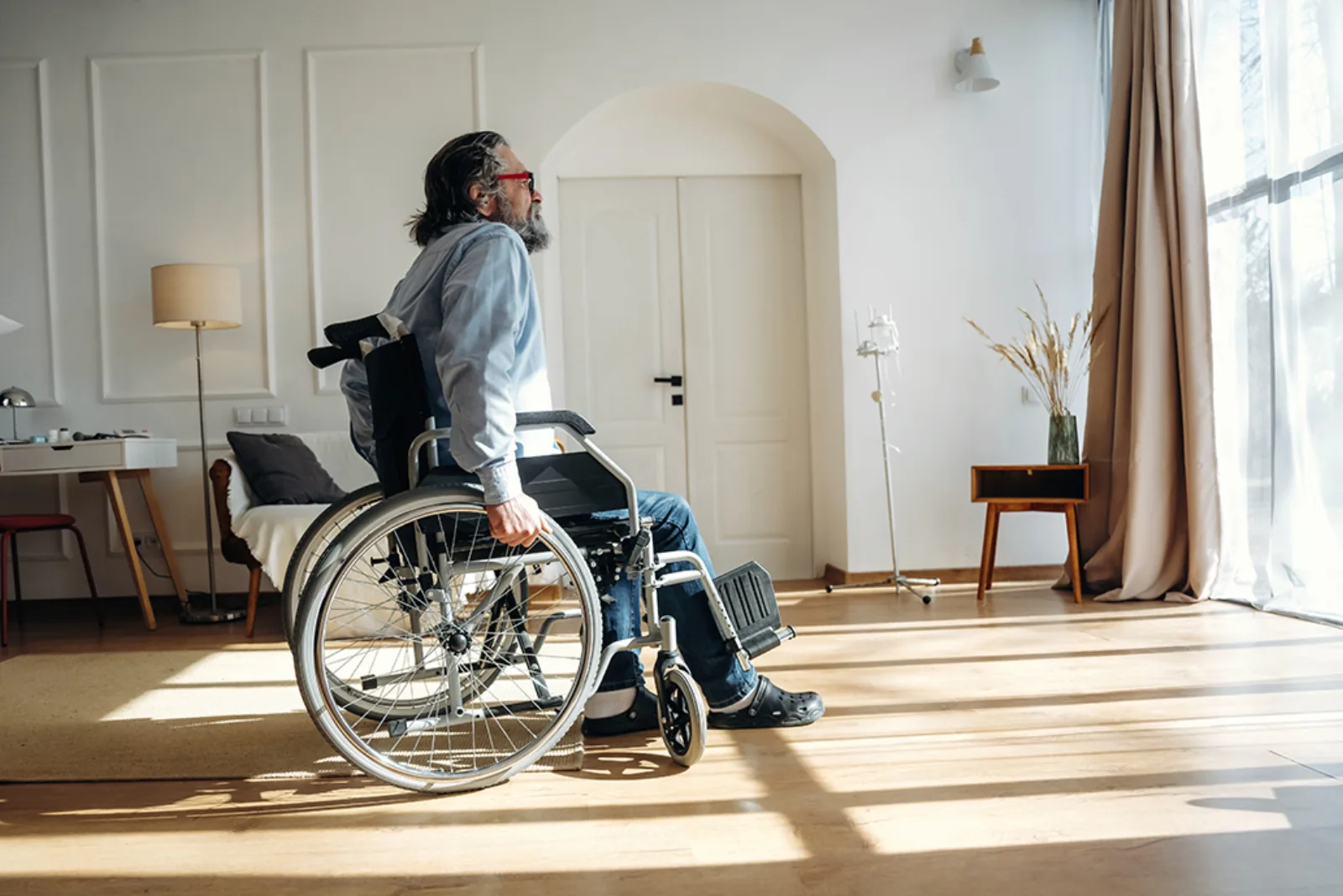
Designing spaces with people with limited mobility in mind is a topic that for years has been reserved for public architecture. Today, it also increasingly applies to private apartments and houses - due to the aging of the population, long-term recovery from injuries or simply a conscious decision to furnish a house that will be comfortable for everyone. A wheelchair, a walker, crutches, a stroller - these devices place demands on the floor that are worth knowing already at the renovation planning stage.
What requirements does a wheelchair place on the floor?
A wheelchair loads the floor in a much more concentrated way than a walking person. The weight of the user and the wheelchair itself is carried by four or six wheels with a relatively small contact area with the floor. In addition, there is intense traffic along the same routes - an electric wheelchair can cover the same dozen or so meters between the bedroom, bathroom and living room all day long. The tires and wheels of the trolley act on the floor like miniature rollers - they wear down the surface in fixed places and may cause visible abrasions if the wear layer of the panel is too thin.
Why SPC vinyl planks work well with a wheelchair
The hard, mineral SPC core is resistant to point loads. Unlike first-generation flexible PVC panels that dented under wheels, the SPC core maintains its structure even under long-term, intense loads.
The smooth, uniform surface makes the trolley easier to roll. Glued vinyl panels create a tight, uniform surface with no moving joints and no level differences between panels - which is an important advantage in a space adapted for people with limited mobility.
When choosing one collection of panels for the entire apartment, you can completely eliminate thresholds between rooms. A threshold, even 1 cm, can be a serious obstacle for a wheelchair or walker.
Thickness of the wear layer – a key parameter
For spaces used with a wheelchair, we recommend panels with a wear layer of at least 0.5 mm, preferably 0.55 mm. A thicker wear layer means a longer time for abrasions to appear on the most frequently used sections. The usability class should be at least 32 - the intensity of use of the wheelchair in fixed places exceeds typical household loads.
Glued vs. snap assembly
For spaces used with a wheelchair, we strongly recommend glued assembly. When maneuvering, the wheelchair exerts lateral forces on the floor, which, with a click system, can over time loosen the connections between the panels and cause visible gaps. With glued assembly, this force is transferred directly to the substrate, without loading the edge locks. The glued floor does not spring under the trolley wheels and is absolutely even at the joints between the panels.
Anti-slip – important for people with limited mobility
A person using crutches or a walker leans on the floor with greater force and at different angles than when walking normally. VTL vinyl panels have a textured surface ensuring a safe coefficient of friction. Panels with a more visible wood-like relief or stone structure provide better support for the foot and rubber tips of the balls than smooth and shiny surfaces.
Thresholds and transitions – how to eliminate barriers
One floor across the entire area - choosing one collection of vinyl panels for all rooms eliminates the need to use leveling thresholds. If we use two different floors, the difference in levels should be minimal - glued vinyl planks are usually 2-3 mm thick and combine well with ceramic tiles of similar thickness. The threshold at the entrance to the apartment should be as low as possible and with a rounded profile - it makes it easier to pass with a stroller.
Baby stroller – similar rules
A stroller places similar demands on the floor, although usually with less intensity. The wheels of a baby stroller, especially when entering from the outside, bring in mud, sand and moisture. Vinyl panels in the hall are resistant to moisture and easy to wash - both properties that SPC panels provide without compromise. A wear layer of at least 0.5 mm is also recommended for this application.
Summary
Vinyl panels with an SPC core, mounted with glue, with a wear layer of at least 0.5 mm and a usability class of at least 32 are a good flooring solution for spaces used with a wheelchair. A smooth, uniform surface without thresholds facilitates movement, the hard mineral core resists point loads from wheels, and one collection across the entire area eliminates thresholds between rooms.
Looking for the perfect floor?
Discover our full range of vinyl flooring and find the ideal solution for your interior.
Want to see our articles more often in Google?
Add VinylTechLab as a preferred source in Google Search so our guides and inspiration appear more often for you.
Add in Google